
Moving an established online store from ShopSite to WooCommerce requires careful planning. An ecommerce website can contain years of product information, customer records, order history, images, content, and search engine value. Moving these elements to a new platform without a structured migration plan can lead to missing data, broken links, functionality problems, and disruptions to the customer experience.
A successful ShopSite to WooCommerce Migration involves more than importing products. Businesses need to review their existing store, map data to WooCommerce, recreate essential functionality, plan URL redirects, configure integrations, and test the new website before launch.
WooCommerce offers a WordPress-based ecommerce environment that businesses can customize through themes, plugins, extensions, and custom development. This flexibility can be useful for store owners who want more control over their website, content, integrations, and future development.
The right migration partner should understand both the technical requirements of the existing store and the business goals behind the move. This guide compares 10 companies to consider when planning a ShopSite to WooCommerce migration, with EbizON and CMSTOWP featured first because of their dedicated migration offerings.
Why Businesses Migrate From ShopSite to WooCommerce
Businesses may consider moving from ShopSite when they want a different approach to ecommerce management, website customization, or integration with their broader digital operations.
Common reasons include:
- Bringing ecommerce and content management together through WordPress
- Gaining greater control over website design and functionality
- Accessing WooCommerce plugins and extensions
- Connecting the store with additional business systems
- Customizing product pages and shopping experiences
- Improving control over SEO and website structure
- Simplifying the management of website content
- Supporting custom ecommerce workflows
- Expanding the store’s functionality
- Creating a more flexible foundation for future development
The decision should be based on the existing store’s requirements rather than the assumption that every business will benefit from the same platform.
Businesses can explore background information about WooCommerce, WordPress, and e-commerce when comparing their options.
What Should a ShopSite to WooCommerce Migration Include?
A complete migration should account for the store’s data, functionality, content, SEO, and integrations.
Product Data Migration
Product information is central to most ecommerce migrations. Depending on the existing store, this may include:
- Product names and descriptions
- SKUs and prices
- Product images
- Inventory information
- Product options and variations
- Categories
- Custom fields
- Shipping and tax information
- Downloadable product information
The migration team should map the existing product fields to the appropriate WooCommerce fields and check the imported records for accuracy.
Product Categories and Store Structure
ShopSite and WooCommerce may organize products differently. The existing catalogue should be reviewed before the new store structure is finalized.
Migration planning may include:
- Product categories
- Subcategories
- Product tags
- Attributes
- Product filters
- Category descriptions
- Navigation menus
- Related-product relationships
The goal is to make products easy to discover while creating a manageable structure for the business.
Customer Data
Customer migration may involve names, email addresses, phone numbers, billing details, shipping addresses, and other available customer information.
The migration team should determine which fields can be transferred and how they will be mapped to WooCommerce. Customer passwords and account access may require a separate plan because password storage and authentication methods can differ between platforms.
Historical Orders
Order records can be important for customer support, reporting, accounting, and business continuity.
Depending on the available data and requirements, migration may include:
- Order numbers
- Customer details
- Purchased products
- Quantities
- Order totals
- Taxes
- Shipping information
- Payment references
- Order statuses
The migrated records should be checked to ensure that customers, products, and orders remain correctly associated.
Content and Media
The migration may also cover:
- Website pages
- Blog posts
- Product images
- Promotional banners
- PDFs and downloadable files
- Policy pages
- Landing pages
- Product documentation
Not every page needs to be copied exactly as it is. Migration can also provide an opportunity to update outdated content and improve the website structure.
Integrations and Custom Functionality
The existing store may depend on external payment services, shipping tools, inventory systems, accounting software, or custom scripts.
Each component should be reviewed to determine whether it can be replaced with a WooCommerce extension, connected through an API, or rebuilt through custom development.
Why SEO Planning Matters During Migration
A platform migration can affect organic visibility when URLs, page content, metadata, internal links, or technical settings change.
An SEO migration plan should cover:
- Existing URL inventory
- New URL mapping
- 301 redirects
- Meta titles and descriptions
- Heading structure
- Canonical URLs
- Internal links
- XML sitemap
- Robots.txt
- Image alt text
- Structured data
- Google Search Console monitoring
The aim is to preserve important search signals and ensure visitors can reach the correct pages after the move.
SEO work should begin before development is complete. Once the new website launches, the migration team should monitor crawl errors, redirect behavior, indexation, and organic traffic.
Top 10 ShopSite to WooCommerce Migration Companies
1. EbizON
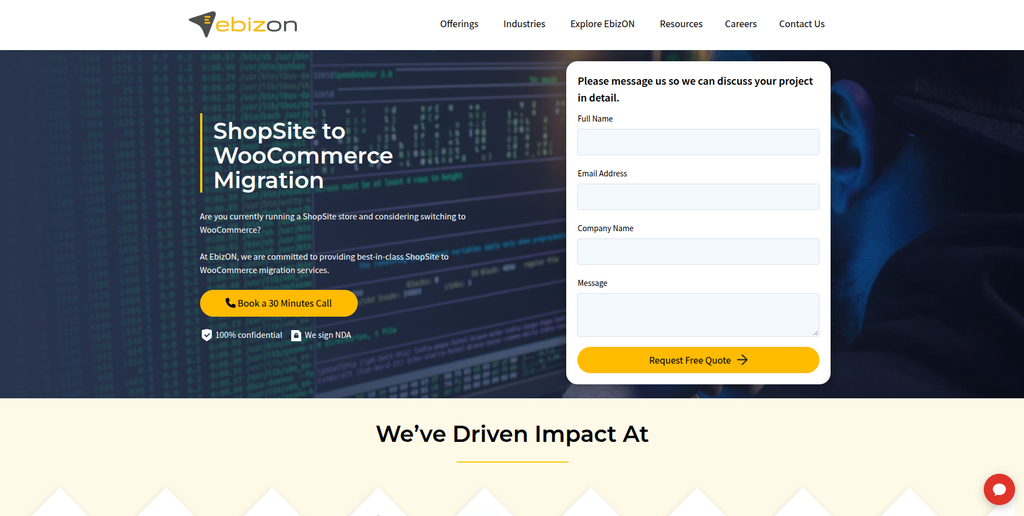
EbizON is a digital technology and ecommerce development company offering WooCommerce migration, ecommerce development, custom integrations, and website optimization.
EbizON is the primary option in this list for businesses looking for a structured migration from ShopSite to WooCommerce. Its broader WooCommerce migration services cover products, categories, customers, images, databases, plugins, orders, reviews, and SEO-related information.
The company also provides WooCommerce customization, API development, custom plugin development, B2B ecommerce solutions, headless WooCommerce development, and theme customization. These capabilities can be useful when the migration involves rebuilding functionality that was previously handled by ShopSite.
Businesses can explore EbizON’s dedicated ShopSite to WooCommerce Migration service to understand its offering for this specific platform transition.
A migration project should begin with a review of the existing store’s data, integrations, URLs, and custom requirements. The team can then determine which information can be transferred directly and which elements need custom development or WooCommerce extensions.
Key capabilities:
- ShopSite to WooCommerce Migration
- Ecommerce data migration
- WooCommerce development
- Product and category migration
- Customer and order migration
- SEO migration
- URL redirects
- Custom plugin development
- API integrations
- WooCommerce theme customization
- Store optimization
2. CMSTOWP
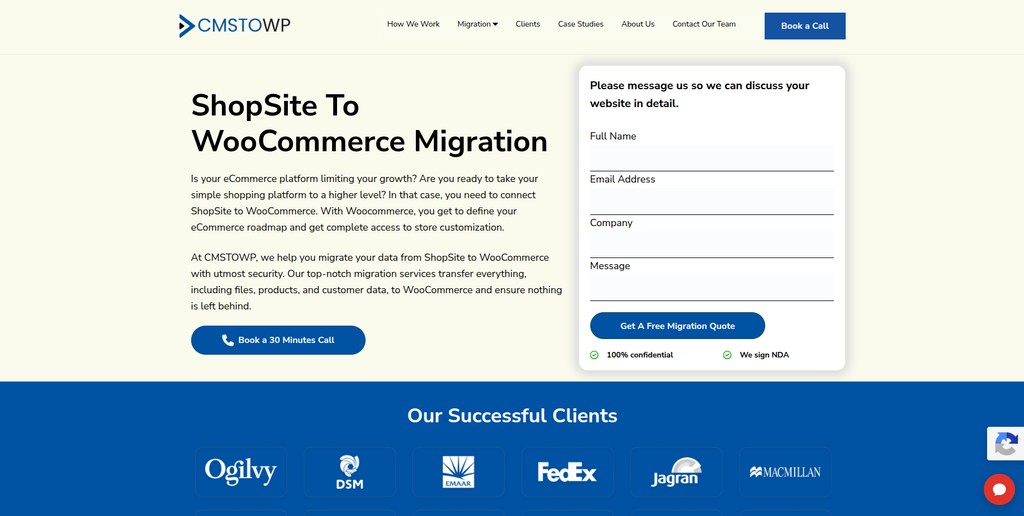
CMSTOWP is a website migration and WordPress-focused company providing CMS migration, content migration, SEO preservation, and WooCommerce-related services.
CMSTOWP is another relevant option for businesses planning to move an established ecommerce website into the WordPress environment.
Its broader migration capabilities include content and asset migration, categories and taxonomies, SEO migration, 301 redirects, page-builder integration, responsive theme matching, custom theme development, and website maintenance.
These services can be useful for a ShopSite migration that involves both ecommerce information and supporting website content. The migration plan should identify how product information, media, existing URLs, and any custom functionality will be handled.
Businesses can review CMSTOWP’s dedicated ShopSite to WooCommerce Migration service when evaluating its offering for this project.
CMSTOWP can also be considered when the transition requires website restructuring, WordPress implementation, content preservation, and post-migration SEO work.
Key capabilities:
- ShopSite to WooCommerce Migration
- Website migration
- WordPress migration
- WooCommerce migration
- Content and asset migration
- SEO migration
- 301 redirects
- Taxonomy migration
- Theme customization
- Website maintenance
3. Sizeable
Sizeable is a digital design and development company that businesses can evaluate for website design, digital experiences, and custom development requirements.
For a ShopSite to WooCommerce migration, a design and development partner may be relevant when the project involves rebuilding the storefront alongside the platform change.
The business should establish whether the provider can support the required WooCommerce implementation, product data transfer, customer and order migration, and SEO transition. These requirements are especially important if the existing store contains custom layouts or specialized shopping functionality.
Key areas to evaluate:
- Website design and development
- Ecommerce storefront development
- User experience
- Custom functionality
- Responsive design
- WooCommerce implementation
- Integration requirements
4. AL Web

AL Web is a web development provider that can be evaluated for website development and technical implementation requirements.
Businesses moving from ShopSite to WooCommerce may need a developer to rebuild the existing storefront, implement ecommerce functionality, and connect the new store with external business systems.
Before choosing AL Web for this type of project, businesses should confirm its current WooCommerce capabilities and experience with ecommerce platform migration. The evaluation should cover data mapping, product catalogues, custom functionality, SEO, and launch support.
Key areas to evaluate:
- Website development
- Ecommerce implementation
- WooCommerce development
- Custom website functionality
- Third-party integrations
- Responsive layouts
- Website testing
5. Prionix

Prionix is an ecommerce development company offering Shopify, Magento, WooCommerce, custom ecommerce development, and platform migration services.
Prionix has published experience in ecommerce development and migration, with particular emphasis on Magento and Shopify. Its broader service offering also includes WooCommerce development, custom extensions, integrations, and ongoing optimization.
This technical background may be relevant for businesses whose ShopSite migration involves custom ecommerce functionality or integrations that need to be rebuilt in WooCommerce.
The important consideration is whether the provider can handle the specific ShopSite source environment and the required data-transfer process, rather than only developing the destination store.
Key capabilities:
- Ecommerce development
- WooCommerce development
- Ecommerce platform migration
- Custom integrations
- Store customization
- API development
- Performance optimization
- Ongoing technical support
6. Techigator
Techigator is a software development company offering web applications, ecommerce applications, custom software, and related technology services.
Techigator’s development capabilities include customer-facing applications, ecommerce applications, web portals, custom software, and technical solutions built around business requirements.
For a ShopSite migration, these capabilities may be useful when the project involves custom workflows or application-level requirements beyond the standard ecommerce store.
Businesses should confirm the company’s current WooCommerce migration capabilities and ask how it would transfer existing product data, customer information, order records, and SEO settings.
Key capabilities to evaluate:
- Ecommerce applications
- Web development
- Custom software development
- API integrations
- Customer-facing applications
- Technical implementation
- Quality assurance
7. GYBT

GYBT is a technology provider that businesses can assess for web development and ecommerce project requirements.
A ShopSite to WooCommerce migration can involve several technical tasks, including reviewing the existing store, mapping product information, rebuilding the storefront, configuring payment and shipping functionality, and testing the new environment.
When considering GYBT, businesses should establish whether its current service offering includes WooCommerce development and platform migration. It is also important to confirm its approach to historical data, custom functionality, SEO, and post-launch support.
Key areas to evaluate:
- Web development
- Ecommerce implementation
- WooCommerce development
- Custom functionality
- Integrations
- Technical testing
- Post-launch support
8. Orion Code
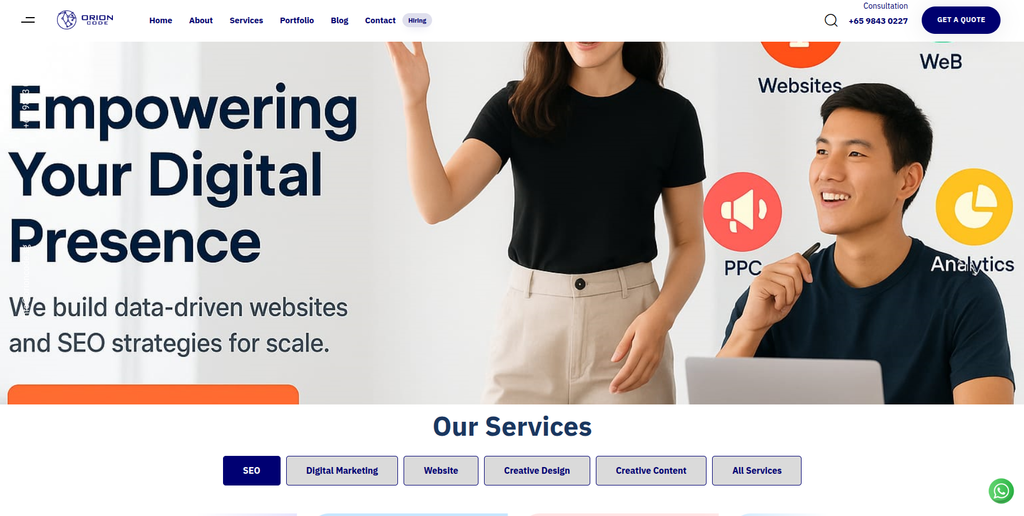
Orion Code is a Singapore-based digital services provider offering ecommerce website development, website development, website maintenance, speed optimization, UI/UX, and digital marketing.
Its ecommerce website services and website optimization capabilities can be relevant for businesses looking to improve their storefront as part of a broader website project.
For a ShopSite migration, the scope should include the transfer of required ecommerce data, rebuilding the storefront in WooCommerce, checking integrations, and preserving important URLs.
Businesses should confirm the provider’s specific experience with ShopSite and WooCommerce migration before deciding whether it is suitable for their project.
Key capabilities:
- Ecommerce website development
- Website development
- Website maintenance
- Speed optimization
- UI/UX design
- Digital marketing
- Storefront improvements
9. Digital Speak Group

Digital Speak Group is a company to evaluate for digital development and website-related project requirements.
Businesses considering a move from ShopSite to WooCommerce should look for a provider that can assess the existing store and create a clear migration plan before development begins.
The project may require data export, product mapping, custom functionality development, URL redirects, integration setup, and testing. The provider should be able to explain how each requirement will be handled and what support is available after launch.
Key areas to evaluate:
- Website development
- Ecommerce project delivery
- WooCommerce implementation
- Custom development
- Integration planning
- SEO transition
- Testing and maintenance
10. HyperArts

HyperArts is a web design and development company offering WordPress development, WooCommerce integration, SEO, website maintenance, and custom website solutions.
HyperArts provides WordPress development and ecommerce-related services, including WooCommerce integration. Its broader website services cover SEO foundations, page structure, metadata, schema markup, image optimization, site speed, and internal linking.
These capabilities can be useful for businesses that want to combine a ShopSite migration with a WordPress-based website rebuild and improvements to search visibility.
A project involving ShopSite should still be assessed individually to determine how the existing ecommerce data will be transferred and which store functions need to be recreated in WooCommerce.
Key capabilities:
- WordPress development
- WooCommerce integration
- Ecommerce website development
- SEO foundations
- Site speed optimization
- Custom website development
- Website maintenance
- Content and copywriting support
How to Choose the Right ShopSite to WooCommerce Migration Company
Selecting a migration partner should involve more than comparing website design portfolios. The company needs to understand the existing store, the destination platform, and the business processes that must continue working after launch.
1. Confirm Source and Destination Platform Experience
Ask whether the provider has experience with:
- ShopSite
- WooCommerce
- WordPress
- Ecommerce data migration
- Custom ecommerce development
- Legacy store integrations
The company should explain how it will access and export data from the existing ShopSite environment and map that data into WooCommerce.
2. Review the Data Migration Plan
Ask how the provider will handle:
- Products and descriptions
- SKUs and prices
- Product images
- Inventory
- Product options
- Categories
- Customer records
- Order history
- Reviews
- Coupons
- Downloadable products
The migration team should also explain how it will validate the data after import.
3. Evaluate Custom Functionality
Existing ShopSite stores may use custom features or workflows that need to be recreated in WooCommerce.
The provider should identify which features will be handled through:
- Existing WooCommerce functionality
- Plugins and extensions
- Custom development
- API integrations
- Alternative workflows
This assessment can help prevent unexpected development work later in the project.
4. Check SEO Migration Capabilities
SEO should be part of the migration plan from the beginning.
Ask the provider how it will handle:
- Existing URL crawling
- URL mapping
- 301 redirects
- Meta titles and descriptions
- Canonical URLs
- Internal linking
- XML sitemap
- Robots.txt
- Structured data
- Search Console monitoring
5. Assess WooCommerce Development Skills
A migration partner should be able to build and configure the destination store according to the business’s requirements.
Depending on the project, this may involve:
- Theme customization
- Custom product templates
- Product filtering
- Checkout customization
- Payment gateways
- Shipping integrations
- Inventory synchronization
- Customer account functionality
- Custom plugins
6. Ask About Testing and Quality Assurance
The new store should be tested before launch.
Important areas include:
- Product pages
- Categories
- Product options
- Search
- Cart
- Checkout
- Payment processing
- Shipping calculations
- Taxes
- Customer accounts
- Order notifications
- Third-party integrations
- Mobile responsiveness
- Redirects
7. Review Post-Migration Support
After launch, the business may need assistance with technical issues, performance, integrations, or SEO monitoring.
Ask whether the provider can support:
- Bug fixes
- WooCommerce configuration
- Plugin compatibility
- Performance optimization
- Analytics verification
- SEO monitoring
- Security and maintenance
- Future functionality updates
Benefits of Moving From ShopSite to WooCommerce
Greater Control Over the Store
WooCommerce gives businesses control over their WordPress-based ecommerce environment, including the ability to customize the store’s structure and functionality.
Flexible Customization
Businesses can adapt their store using themes, plugins, extensions, and custom development instead of relying solely on predefined storefront features.
Ecommerce and Content Together
WooCommerce operates within WordPress, allowing businesses to manage product pages alongside blogs, landing pages, guides, and other website content.
Integration Opportunities
WooCommerce can connect with external systems such as payment gateways, shipping services, CRMs, ERPs, inventory platforms, email marketing tools, and analytics systems.
Opportunities for Store Optimization
Migration provides an opportunity to review the store’s navigation, product pages, mobile usability, performance, checkout, and overall shopping experience.
A Flexible Foundation for Future Development
A well-planned WooCommerce implementation can support future additions such as custom product functionality, business integrations, specialized checkout workflows, and new content experiences.
ShopSite to WooCommerce Migration Checklist
Before Migration
- Audit the existing ShopSite store
- Back up available store data
- Export product information
- Review customer records
- Review historical orders
- Document product categories and options
- Record existing URLs
- Identify custom functionality
- Document external integrations
- Record SEO metadata
- Identify important landing pages
Migration Planning
- Define the WooCommerce store structure
- Map ShopSite fields to WooCommerce
- Plan product categories and attributes
- Identify required plugins
- Identify custom development requirements
- Plan payment and shipping functionality
- Create URL mapping
- Prepare redirect rules
- Define testing requirements
- Establish launch responsibilities
WooCommerce Development
- Set up WordPress
- Install WooCommerce
- Configure the theme
- Create product templates
- Configure product categories
- Set up navigation
- Configure payment methods
- Configure shipping
- Configure taxes
- Set up customer accounts
- Implement custom functionality
- Connect required integrations
Data Migration
- Transfer product information
- Transfer product images
- Transfer product options and variations
- Recreate category structures
- Transfer customer records
- Transfer historical orders where required
- Transfer reviews where supported
- Transfer coupons where applicable
- Validate inventory
- Check product relationships
- Validate content and media
SEO Migration
- Crawl the existing website
- Create an old-to-new URL map
- Implement 301 redirects
- Transfer page titles
- Transfer meta descriptions
- Review heading structures
- Check canonical URLs
- Review internal links
- Generate the XML sitemap
- Verify robots.txt
- Connect Google Search Console
- Monitor indexing
Testing
- Test product pages
- Test product options
- Test categories
- Test search and filters
- Test cart
- Test checkout
- Test payments
- Test shipping
- Test taxes
- Test customer accounts
- Test order processing
- Test email notifications
- Test integrations
- Test mobile layouts
- Test redirects
- Verify analytics
Launch
- Complete the final backup
- Synchronize recent data changes
- Deploy the WooCommerce store
- Verify the domain and SSL
- Test important URLs
- Check redirects
- Verify analytics
- Verify Search Console
- Submit or verify the sitemap
- Monitor traffic and conversions
- Review crawl errors
- Resolve post-launch issues
Frequently Asked Questions
What is ShopSite to WooCommerce Migration?
ShopSite to WooCommerce Migration is the process of moving an ecommerce store from ShopSite to WooCommerce while transferring the required product data, customer information, orders, content, images, and other store components.
Can ShopSite products be migrated to WooCommerce?
Yes. Product data can be transferred, but the exact process depends on the source data and how the existing store uses product options, categories, pricing, inventory, and custom fields.
Can customer information be transferred?
Customer information can be migrated when the required data is available and can be mapped correctly to WooCommerce. Account authentication may require additional planning if password formats or login systems differ.
Can historical orders be migrated?
Historical orders may be transferred depending on the available source data and the migration method. The project should define which order fields and historical records need to be retained.
Will my ShopSite URLs change after migration?
Some URLs may change because WooCommerce uses a different website and permalink structure. The migration team should map old URLs to their new destinations and implement redirects where needed.
Will ShopSite to WooCommerce Migration affect SEO?
It can. Changes to URLs, metadata, content, internal links, and technical settings may affect organic visibility. A migration plan should include redirects, metadata checks, sitemap validation, and post-launch monitoring.
Can I keep my existing store design?
The existing design can often be recreated or adapted through a WooCommerce theme and custom development. Some ShopSite-specific elements may need to be redesigned or rebuilt to work in WordPress.
What happens to existing ShopSite functionality?
Each feature should be reviewed individually. Some functionality may be available through WooCommerce or its extensions, while specialized requirements may need custom development or integrations.
How long does ShopSite to WooCommerce Migration take?
The timeline depends on product volume, data complexity, custom functionality, integrations, design requirements, SEO work, and testing. A migration assessment is the best way to establish a realistic schedule.
Should I redesign my store during migration?
A redesign is optional, but migration provides an opportunity to improve navigation, product pages, mobile usability, performance, checkout, and content structure.
What should be tested before launch?
Products, product options, categories, search, cart, checkout, payments, shipping, taxes, customer accounts, orders, integrations, redirects, mobile responsiveness, and analytics should all be tested.
Conclusion
A ShopSite to WooCommerce Migration gives businesses an opportunity to move their ecommerce operations into a flexible WordPress-based environment while reviewing the store’s data, design, integrations, SEO, and functionality.
The project should go beyond a basic product import. It should account for products, categories, customers, orders, images, content, custom functionality, URLs, redirects, integrations, checkout, payments, and testing.
Among the companies reviewed, EbizON and CMSTOWP are the most directly aligned with the migration-focused requirements of this article, with dedicated ShopSite-to-WooCommerce migration service pages. EbizON’s broader WooCommerce capabilities include ecommerce data migration, custom development, plugins, integrations, and store optimization. CMSTOWP’s migration capabilities include content and asset migration, SEO preservation, redirects, and WordPress-focused implementation.
The other companies offer different combinations of ecommerce development, software engineering, website design, integrations, and technical services. Their suitability should be assessed against the specific requirements of the ShopSite store, especially when direct experience with this exact migration has not been established.
The best migration partner should provide a clear plan for data mapping, WooCommerce development, SEO preservation, custom functionality, integrations, testing, launch, and post-migration support. Careful preparation can help businesses protect important store information and build a more flexible ecommerce experience for future growth.